Want to learn more about avian diet and nutrition, enrichment, and training?
Here’s our Resource Guide.
-
We are a matchmaking rescue. That means that we have the responsibility to find the BEST possible home for each of our birds. We are not first-come-first-serve.
All of our birds have multiple adoption appointments with different families, and we decide which adopter is the best fit. Our adoption process is competitive for our birds’ best interest.
You may have an in-person appointment with one of our birds, fall in love with that bird, and we may decide that another adopter is a better fit.
This is not a personal judgement! It is our responsibility to make sure each of our birds’ next home is their forever home that can meet all of their needs. All birds have complex social, physical, nutritional, and mental needs, and they are individuals with their own preferences and personalities.
We do not hold birds or accept deposits on birds. If you need time to decide whether you want to adopt, please wait to submit an application until you are ready. You MUST meet your bird in person before adoption. Please do not adopt a bird based on photos or videos you saw online.
If we see that you are a suitable home for a parrot, we will keep you in our system and offer future birds to you for adoption if they match your interests and experience level.
-
The first step is to fill out an application for one of our birds. We will send you an email with a link to schedule your virtual interview where we will go over your applications, see where you plan to keep your bird, and answer any questions you have.
Then we move onto the in-person meet-and-greet appointment where you will see your bird in person for the first time and start building your initial bond.
On our end, we will have our avian veterinarian medically clear your bird (exam, fecal sample to check for bacteria, DNA test to rule out common avian diseases).
Before you take your bird home, you must have a travel carrier and cage that meet our minimum dimensions, adequate perching, toys, food, accessories, and a place to perch outside of the cage such as a play stand or training stand.
On take-home day, you will sign our adoption contract, pay the adoption fee, and begin your 3 month foster-to-adopt period.
-
The primary caregiver must be 18+ to adopt a bird, and we do not adopt birds as a gift for another person.
If you do not have experience handling birds, we ask that you gain experience however you can by working with a friend who owns a bird, fostering birds (through us or another rescue), or visiting our birds multiple times. Bird care requires hands-on practice to gain confidence and learn how to ready bird body language.
We want to make sure you are completely prepared to bring your new bird home.
That means that you have enough space, equipment, time, funds, and avian education to keep your bird happy and healthy for the rest of their life.
Anyone who keeps captive wild animals can tell you that their care and medical expenses can be very expensive and time-consuming. Your bird needs to be factored into every aspect of your life including travel, relocation, changes in income, and even ultimately your own passing because birds often outlive their owners.
Parrot adoption is a serious, often life-long commitment, and we ask that you are practically, mentally, and financially prepared for the experience. Best practices are always evolving, so your willingness to learn and change your care over time is essential for the mental and physical health of your bird.
-
For the first three months after you bring your new bird home, we consider you a foster home.
Parrots take time to settle into new environments, and it may take months before your bird is comfortable enough in your home and with you to regularly interact and show their full personality. Birds are naturally vigilant and cautious due to their prey survival instincts.
Taking time to build consistency and trust with your bird is central to forming a true bond, and that process cannot be rushed.
During the foster-to-adopt period, we are here to support you through the initial stages of bird ownership and provide resources for your training and avian education.
If you decide during the initial three month period that the bird is not a good fit, you can return them to the rescue for a partial refund of the adoption fee.
You are financially responsible for the bird’s care, diet, and medical expenses unlike traditional foster homes, and you are not permitted to rehome the bird within the three month period to prevent the bird displacement trauma.
-
Yes! We have no adoption restriction. We just require all potential adopters to come to central Ohio for your in-person appointments.
Most likely, you will need to make two in-person appointments. The first will be to meet your bird, and the second will be to take your bird home.
If you live outside of central Ohio, you may need to plan an overnight stay in the Columbus area in order to meet these requirements. For example, if your meet-and-greet appointment is on a Saturday, you could bring your bird home the following day on Sunday.
-
We focus on larger parrots including conures, Quakers, Ringnecks, Amazons, cockatoos, African Greys, Eclectuses, and Macaws. Occasionally we have smaller birds available, but we have partnerships with organizations that specialize in small parrot rescue.
-
Our adoption fees are 20% higher than the fees of other similar rescues. This is because we invest significant care and resources into each of our rescue birds.
Every bird we take in is converted from their original diet to a diet focused on variety, optimal health, and meeting their individual needs. This includes fresh chop, sprouted grains and beans, cold-pressed pellets, and a variety of mix-ins like edible flowers, spices, herbs, pods, nuts, and occasional fruit.
We also start out our birds with target training in their foster homes including a reliable step-up and handleability training. Our birds are set up for success in a home environment with at least 3 hours of out of cage time daily and consistent exposure to family routines.
We do not have a rescue facility, and each of our foster homes only has one foster bird at a time so that they can give their full attention to the bird in their home.
Before being cleared for adoption, each of our birds is examined by an avian veterinarian, DNA tested for common diseases including chlamydia, and a fecal scan is completed to rule out bacterial infections. If any conditions are diagnosed by our veterinarian, our birds are placed on medical hold until their symptoms are cleared or there is a plan in place for their ongoing care in the case of a long-term condition.
We also DNA sex all of our birds which is helpful information for future owners with other birds of the same species in the house and for future health planning including sex-specific concerns.
All of our adoption fees, donations, membership fees, and the purchases of our training stands and toys go toward paying for vet fees, insurance, equipment like cages and perches, and travel expenses for surrenders. Some surrenders require out-of-state travel and renting equipment like u-hauls.
Ohio Free Flight Club and Rescue is a completely volunteer-run organization, and our birds are fed by fosters from their own personal funds. We minimize expenses as much as possible, but running a rescue in any capacity is expensive, especially when adhering to our high standards.
Our birds deserve the best possible care, and we do everything we can to prepare them for their forever homes.
-
This really depends on the bird and your situation.
If you have already demonstrated to us that you have adequate experience with birds and knowledge about parrot care, enrichment, diet, and training, and you have an approved cage and travel carrier, then it is possible to take your bird home on meet-and-greet day.
We also need to see you handle the bird during your appointment and determine whether the bird is comfortable with you.
Some birds need multiple in-person appointments with their new families before take-home day. Some birds adjust more easily to change and can go home the same day. Rescue admin will determine what is best for your bird based on their personality and history and your level of experience.
-
We are a bird rescue, so we never know when specific species will be surrendered to us.
We are a limited-capacity, foster-based rescue which means that we will never have more than six parrots available at any time. Our limit is two large birds, two medium birds, and two small birds.
We want each of our birds to receive the best possible care, so we purposely do not overload our rescue admin or our foster homes.
If you are interested in a certain parrot species, please let us know, and we will contact you the next time we have a bird that matches your interests.
-
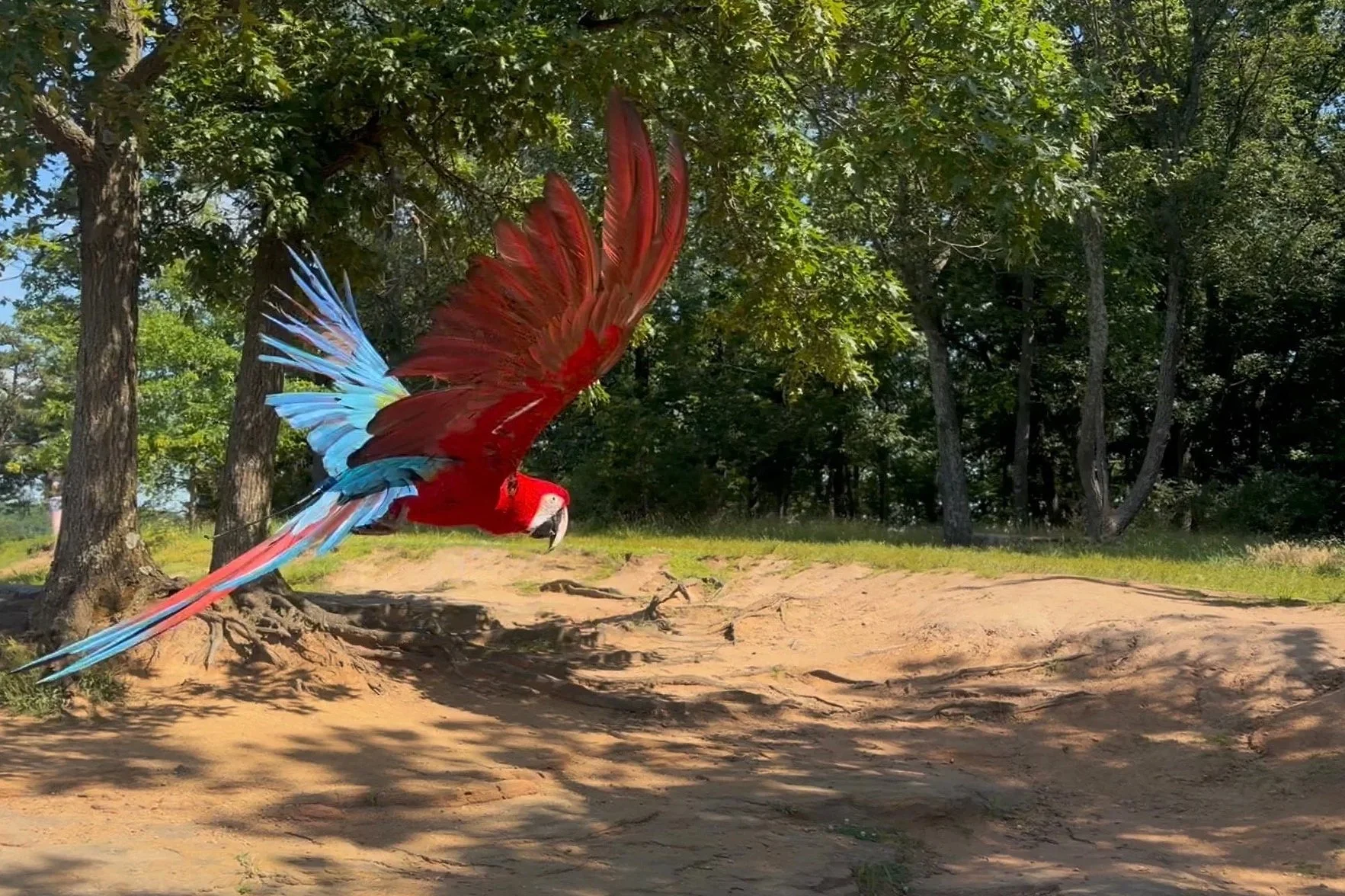
The majority of birds are not true free flight candidates because free flight requires a high level of flight skill. We need our birds to be able to evade hazards like birds of prey in an emergency situation.
While we do everything in our power to keep our birds safe, the environment outside can change in an instant. It is important for free flight birds to be able to make life-saving decisions and to be able to physically out fly a predator.
Successful free flyers are birds that use flight as their main form of transportation and are able to quickly change direction, complete u-shaped boomerang flight patterns, and have the strength to ascend and descend.
Free flight is built on the trust and bond between the bird and their handler. The bird needs to find the reward of being with their handler more motivating than anything else, and their handler needs to be their safe place when they are in a panicked situation. Birds that have the instinct to fly off and not to their handler are not suited for free flight.
To assess your own bird, ask yourself:
Is my bird physically fit enough to evade a bird of prey?
How strong is my bond with this bird? Are they more likely to fly to me or away from me in an emergency situation?
Is my bird capable of making life-saving decisions, or are they likely to freeze? Do I see my bird exhibiting signs of vigilance like scanning the sky for hazards, or do they seem unaware of their surroundings?
It is important that you assess your bird’s capacity as objectively as possible.
If your bird is not a free flight candidate, that doesn’t mean that outdoor flight is not possible for them. They may do better outside on a harness, in a flight cage, or practicing flight recall inside of an aviary or a secure batting cage.
-
We do not teach any kind of course, class, or workshop on free flight or bird training.
We are not professional trainers, and while we can offer support and advice based on our own experience, we are not free flight experts.
The purpose of our training club is to provide resources on bird care and training while also being a supportive community for its members. We can learn from each other, and we are all on this free flight journey together.
Remember that no matter how much experience you have, there is always something new to learn, and we are always finding ways to improve our care.
-
Each bird’s journey to free flight is different based on that bird’s previous experience, level of training, and bond with their handler.
Generally, the process follows these steps:
Target training: The bird learns to touch a target in exchange for a reward.
Extended target training: The bird learns to move around the house to touch the target.
Indoor recall training: The bird learns to fly from a perch to their owner’s hand and back to the perch. This is then extended to indoor recalls where the handler is out of sight and the distance is expanded (i.e. in a warehouse).
Outdoor recall training: The bird puts these lessons together to recall outside and target outdoor perches. This is coupled with desensitization training to prevent the bird from flying off when they are faced with unfamiliar stimuli.
This training path does not apply to all birds, and some birds will need more or less time on each of these steps. Most birds will never reach the outdoor free flight stage of training due to the factors discussed in previous questions.
The only person who can truly determine if a bird is ready to move onto the next step of training is the bird’s owner. They know their bird better than anyone else.
Training is not linear, and often progression in one area comes with regression in another area. Training for all birds is most effective when it is consistent, clear, and responsive to the bird’s needs.
-
Free flight is risky! We are the first to tell you that flying your bird outside unrestrained comes with inherent risks than cannot be completely eliminated.
Your bird could fly off never to be seen again despite recall training. There are birds of prey in our area that could quickly descend on your bird before you see them coming. A sudden gust of wind could carry your bird off, and your bird could be impacted by the many hazards that exist outside including power lines and cars. These are all real threats that all handlers need to take into account when deciding whether free flight is right for their birds.
The best way to respond to a fly-off is to prepare before it happens. If your bird has a GPS tracker, you can follow the signal to find them. If they do not have a tracker or the tracker is inaccurate, you can bring high-level rewards to the site they were last seen and attempt to flock call with your bird. Most trained birds will attempt to communicate with and return to their handlers.
In addition to physically searching for your bird in a 5 mile radius of where they were last seen, post a message to local bird groups on Facebook including Parrot 911 asking people to keep an eye out for your bird. Include clear videos and photos of your bird and specific instructions for anyone who finds your bird.
For our birds, we have decided that the risks of free flight are worth it because outdoor flight allows them freedom like nothing else. They are able to make decisions with complete autonomy, engage in the natural behavior of flight, and enjoy the sun on their feathers and the fresh air on their faces.
As a handler, you are able to bring your bond with your bird to the next level and truly explore how deep the trust between an animal and their person can go.
Free flight is risky, and it is also an experience like nothing else. If you decide that free flight is right for you and your bird, we are here to share in the wonder and responsibility of this journey with you.
Frequently Asked Questions